Telegram
Purpose
Run snsagent as a Telegram bot: each message drives a real agent session (message → handler → session → agent → model → tool → response → Telegram). The adapter lives in src/adapters/telegram/ and is built on grammY.
How it works
- The bot polls Telegram when
SNS_TELEGRAM_BOT_TOKENis set (auto-boot), or when started explicitly withsnsagent telegram. - Each chat maps to an agent session; incoming text becomes a user turn, and the agent’s reply is sent back through the bot.
- Eleven slash commands are wired:
/start /help /chat /reset /status /memory /cron /model /code /review /task. File upload/download is supported.
Configuration
export SNS_TELEGRAM_BOT_TOKEN="your-bot-token-here"
export SNS_TELEGRAM_ALLOWED_USERS="123456789"   # your numeric Telegram user id
export SNS_TELEGRAM_AUTOSTART=0                 # optional: disable auto-boot
snsagent
Real example
You (Telegram):  what files changed since yesterday?
Bot:             Ran `git diff` … 3 files changed.
You (Telegram):  /status
Bot:             Session: active · model: claude-sonnet · backend: mnemopi
Screenshot
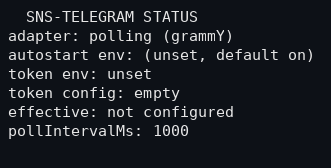
snsagent telegram status shows the adapter state and no secrets: token fields display as unset/empty. A real conversation screenshot is not committed because it would contain the configured bot token / chat contents.
Authorization
- When
SNS_TELEGRAM_ALLOWED_USERSis set, only the listed user ids (and group chats they author) are served; anyone else is rejected before the agent is consulted. - When it is unset, a warning is logged and the bot serves any sender.
the allowlist is opt-in. A deployment without it is an unauthenticated remote-execution surface. Keep SNS_TELEGRAM_ALLOWED_USERS set.
Sessions run tools with autoApprove: true, so the allowlist narrows who can talk to the agent, not what actions are auto-approved. Review the boundary in security-model.md before exposing a bot.
Failure behavior
- No token → the adapter does not start (or
snsagent telegramerrors). - Network/polling errors are retried by grammY; transient failures do not kill the agent process.
Testing
bun test test/telegram-audit.test.ts   # handler + auth-gate coverage
bun test test/telegram.test.ts
The test suite covers the message → handler → session path and the SNS_TELEGRAM_ALLOWED_USERS authorization gate (rejection of unlisted users, warning when unset).